Jack Stand Safety Ratings Explained: What the Numbers on the Label Actually Mean
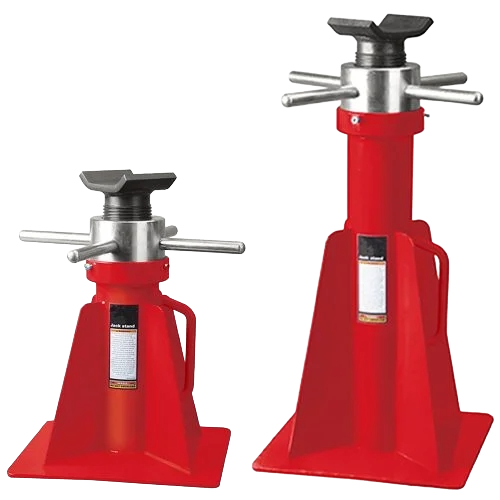
The number stamped on a jack stand's label — 2 ton, 3 ton, 6 ton — tells you the maximum load that single stand is rated to hold safely, tested and certified under a specific industry standard, usually ANSI PALD or ASME PASE. It is not a combined figure for a pair, not a suggestion, and not something you round up on. Misreading that number, or ignoring how it was tested, is exactly how vehicles end up on the shop floor instead of in the air.
What the Tonnage Number Actually Represents
Here's a mistake we see constantly: a shop buys a pair of 3-ton stands and assumes they've got 6 tons of support. Wrong. Each stand is rated individually for that load — 3 tons per stand, full stop. If you're supporting a 5,000 lb truck with two 3-ton stands, you're within spec on paper, but you've got zero margin if the load isn't perfectly centered.
The rated capacity is also the maximum static load, meaning the vehicle sitting still. It assumes proper contact with a flat, load-bearing point on the frame — not a pinch weld, not a plastic rocker panel cover. Put the saddle in the wrong spot and the rating on the label becomes meaningless, because the failure mode shifts from the stand to the contact point.
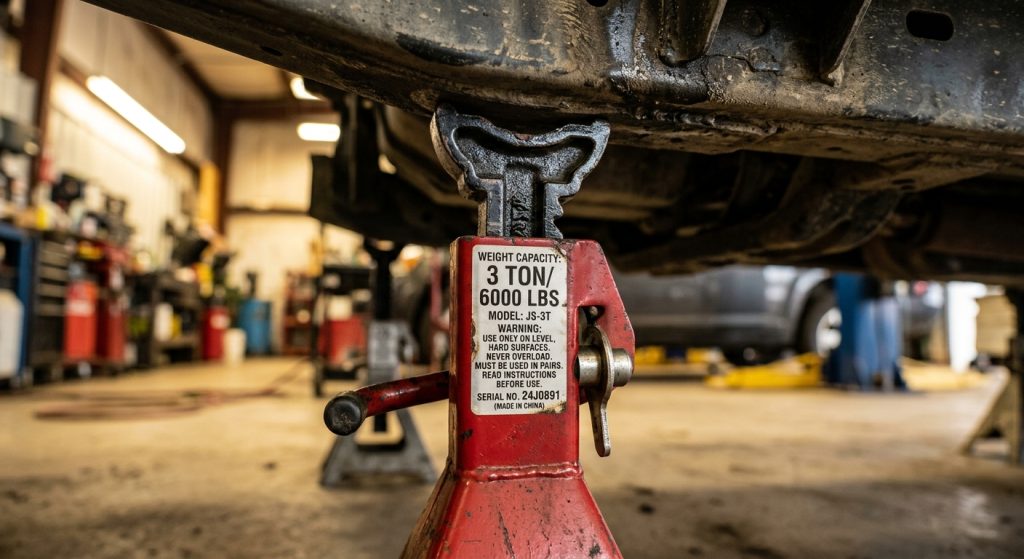
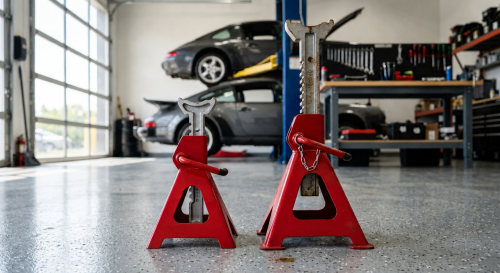
Jack stand tonnage label stamped on steel frame
Who Sets the Standard — And What Gets Tested
Most quality jack stands sold in North America reference ANSI PALD (Portable Automotive Lifting Devices) or the older ASME PASE-2013 standard. These aren't marketing badges — they require third-party testing that includes a proof load test at a multiple of the rated capacity, typically 2x to 3x, along with a static load hold test where the stand must support the rated weight for a sustained period without deformation.
Why This Matters for Repeat Buyers
Stands that only carry a CE mark or no certification at all may still hold weight — until metal fatigue sets in after repeated cycles. A stand tested once at 3x capacity in a lab is a different animal than one that's never been tested and just happens to look similar. If a supplier can't tell you which standard their stands are certified to, that's a red flag worth walking away from.
Jack stand undergoing proof load testing in a lab
Ratcheting vs. Pin-Style Locking — Different Failure Points
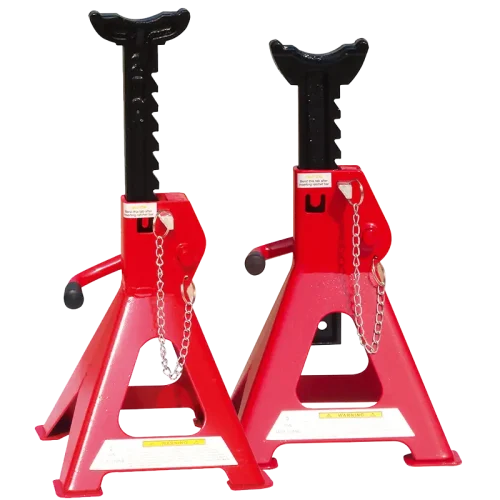
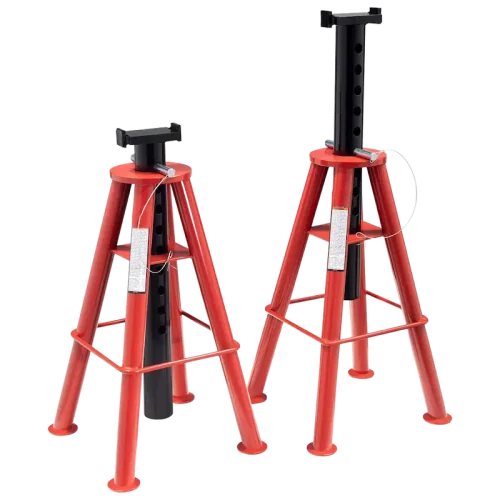
The locking mechanism matters just as much as the tonnage rating, and it's often overlooked. Pin-style stands lock at fixed height intervals through a solid steel pin — simple, strong, and predictable, but you're limited to those preset notches. Ratcheting stands offer infinite height adjustment but rely on a ratchet tooth engagement, which under repeated heavy use can wear down faster than a solid pin.
For heavy-duty work — trucks, vans, fleet vehicles — pin-style stands are generally the safer long-term choice because there's less mechanical wear on the load-bearing component. Ratcheting stands are fine for lighter passenger vehicles where the convenience of fine height adjustment outweighs the slightly higher wear risk.
A Real Shop Scenario: When 3-Ton Stands Weren't Enough
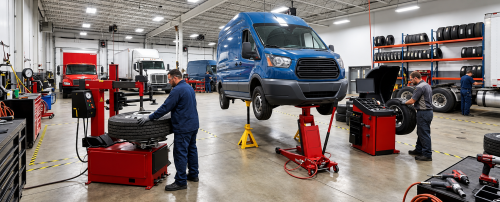
A fleet maintenance garage servicing delivery vans ran 3-ton stands for years without issue — until they picked up a contract for box trucks with a curb weight over 10,000 lbs. The crew kept using the same 3-ton stands, reasoning that the truck's weight was distributed across four contact points. It wasn't distributed evenly. Uneven ground and a slightly off-center frame contact overloaded two stands well past their rating, and one buckled during a brake job.
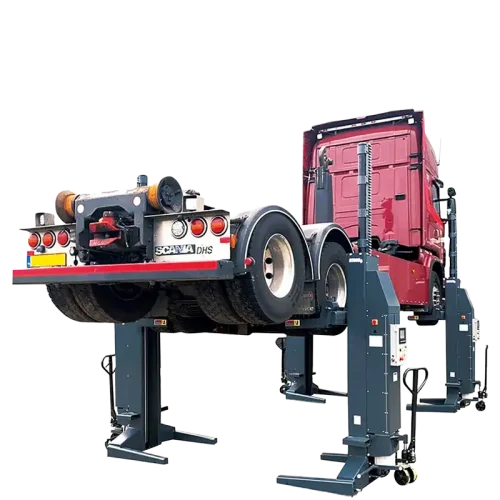
The fix was simple: 6-ton stands became mandatory for anything above van-class weight, with capacity clearly posted at each bay. If your service mix is shifting toward heavier vehicles, check out our truck and bus workshop lift guide before assuming your existing stands will scale with the job.
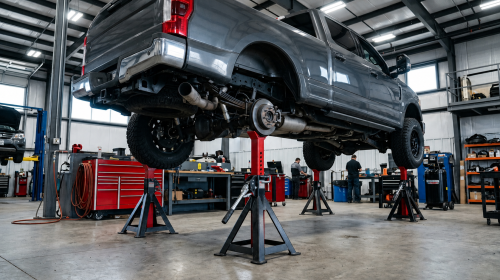
Heavy-duty jack stands supporting a delivery truck in a fleet garage
Matching Capacity to Actual Curb Weight — Not Just Vehicle Class
Vehicle curb weight varies more than most techs assume. A base-trim pickup and a loaded crew-cab diesel version of the same model can differ by 1,500 lbs or more. Relying on “it's a truck, so 3-ton is fine” is a guess, not a calculation.
Check the vehicle's actual curb weight on the door jamb sticker or manufacturer spec sheet
Divide by the number of contact points, then add at least 25% margin for uneven weight distribution
Round up to the next available stand capacity — never round down to save money
This margin matters more when a vehicle has aftermarket modifications — lift kits, heavy bumpers, bed toolboxes — that shift weight distribution away from factory specs.
Signs a Rated Stand No Longer Deserves Its Rating
A label doesn't mean much once the stand has been damaged. Deformed base legs from a stand tipping over, a bent locking pin, or corrosion around the ratchet teeth all quietly reduce the actual safe capacity below what's printed. None of these show up unless someone actually inspects the stand — most shops just grab whatever's closest.
Quick Inspection Checklist
Base legs sit flat and don't wobble on a level floor
Locking pin or ratchet engages fully without forcing it
No visible cracks, weld separation, or rust scaling at stress points
Saddle isn't bent or worn unevenly
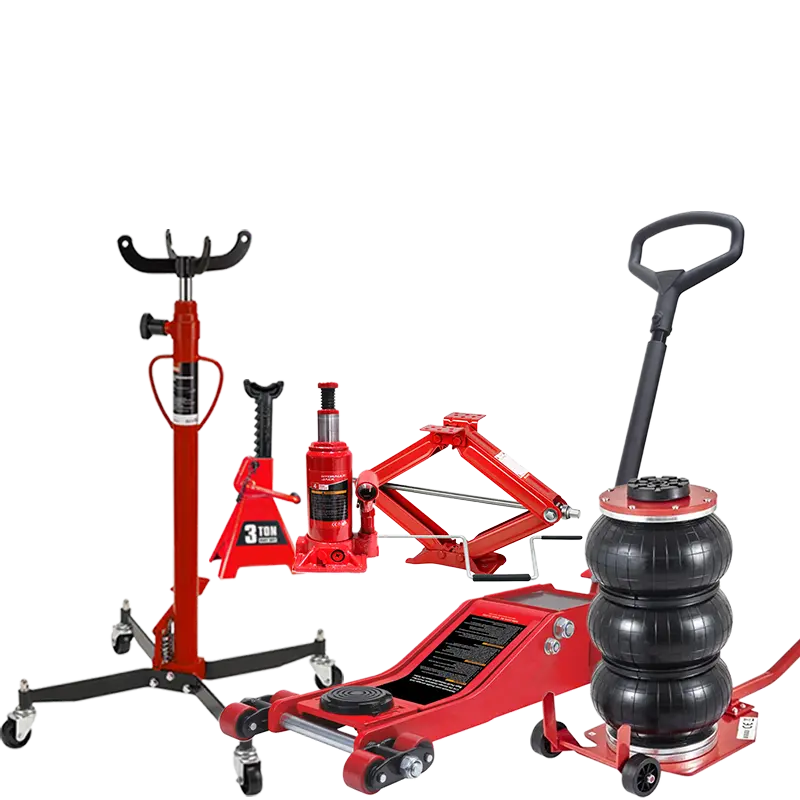
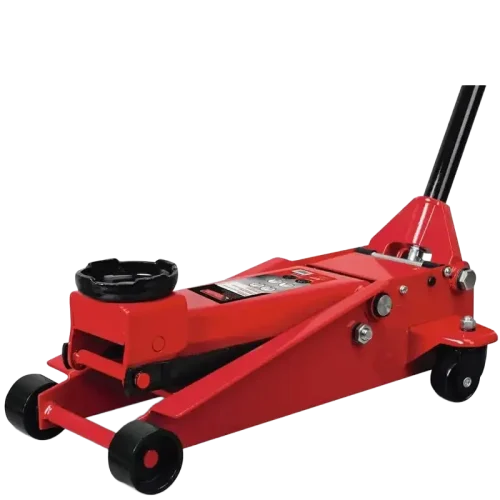
Jack stands are only half the setup — they pair with a hydraulic floor jack that raises the vehicle, and the same inspection discipline applies to both.
Mechanic inspecting jack stand locking pin for wear and damage
Why Buying the Highest Rating Isn't Always Smarter
It's tempting to just buy 6-ton stands for everything and never think about it again. But bigger stands are taller at minimum height, heavier to carry, and often have a wider base footprint that doesn't fit under low-clearance sports cars or lowered vehicles. A shop servicing mixed passenger vehicles and the occasional truck is usually better off with two sets — 2-ton for daily sedan work, 3 or 6-ton for anything heavier — rather than one oversized set that's awkward for 80% of the jobs.
Workshop layout plays into this too. If bay space is tight, storing multiple stand sizes needs planning — something worth factoring into your overall workshop layout and equipment planning.
How Jack Stands Fit Into a Broader Lift Safety Routine
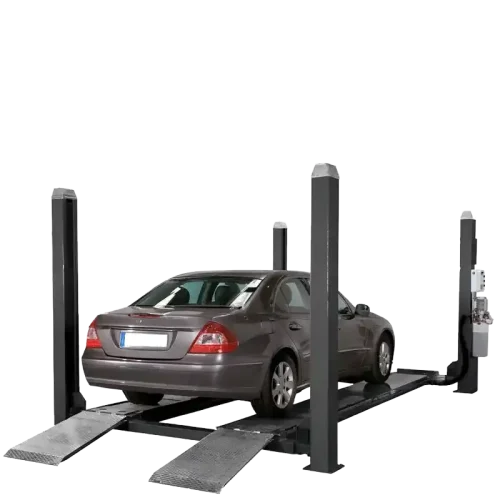
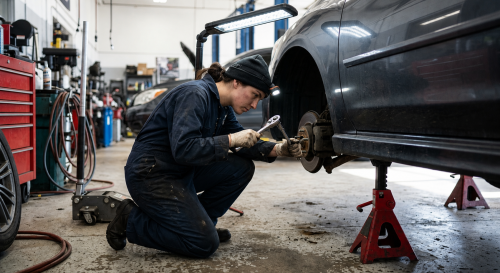
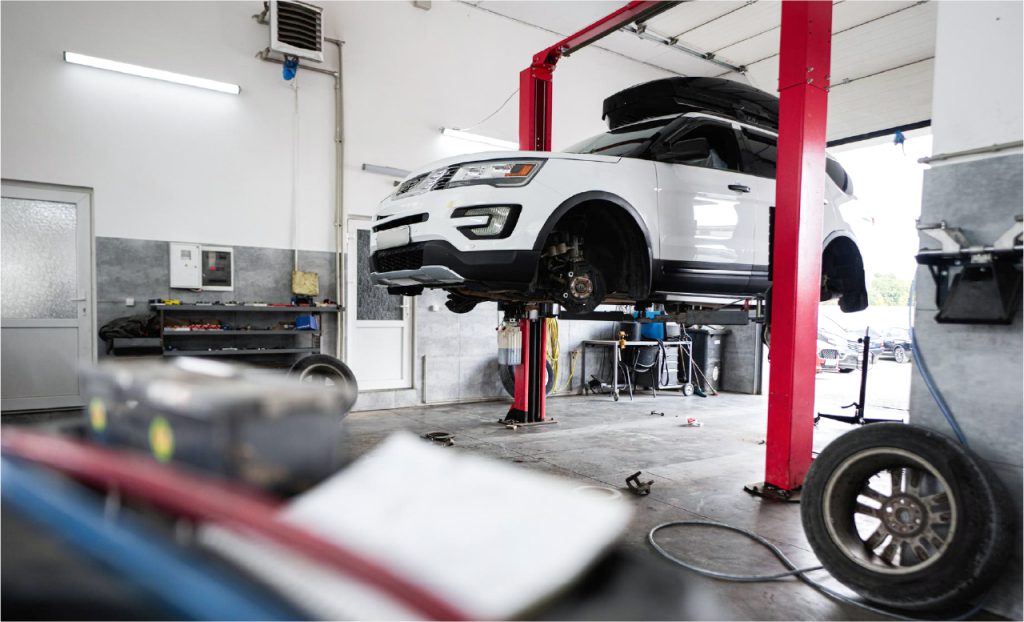
Jack stands are a backup and secondary support — they should never be the primary lifting device, and they should never be trusted alone without checking the vehicle's stability on them before crawling underneath. Shops running two-post or four-post lifts still keep stands on hand for supplemental support during heavy component work like transmission or subframe jobs. If you're deciding between lift types for your bay, our 2-post vs 4-post lift comparison breaks down where stands typically come into play as a secondary safety layer.
Yes. We provide OEM and ODM services, including logo printing, custom colors, packaging design, and product specification adjustments. Available options depend on the product type and order quantity.
What is your minimum order quantity (MOQ)?
MOQ requirements vary by product. Most standard products are available in flexible quantities, while customized branding, packaging, or product development may require a minimum order. Contact us with the product model and required quantity for confirmation.
Do you offer samples?
Samples or trial orders are available for most product categories. Sample charges and refund terms depend on the selected product and will be confirmed before ordering.
Which ports do you ship from?
We can arrange shipment from major ports in China, including Shanghai, Ningbo, Shenzhen, and Qingdao. The final port will be selected according to the product location and shipping arrangement.
Which trade terms do you support?
We support EXW, FOB, CIF, and other standard international trade terms. The available option will be confirmed in your quotation based on the order and destination.
Can you supply products beyond your catalog?
Yes. If you cannot find the required automotive tool or workshop equipment in our catalog, send us your specifications, target quantity, and application. Our team can help identify and source a suitable solution.