3 Ton vs 6 Ton Jack Stands: Which Capacity Fits Your Vehicles?
For most passenger cars, sedans, and light SUVs, 3-ton jack stands (rated 6,000 lbs each) provide plenty of margin. Once you’re supporting full-size pickups, cargo vans, or anything with a curb weight over 5,000 lbs, you need 6-ton stands (12,000 lbs each) to keep a safe capacity buffer. The real decision isn’t about which number sounds tougher — it’s about matching rated capacity to the actual weight sitting on each stand, per corner, not per vehicle.
The Math Nobody Does Before Buying Jack Stands
Here’s a mistake we see constantly: a shop owner checks the vehicle’s total curb weight, sees it’s under the stand’s total rating, and calls it good. Wrong approach. Jack stands support one corner of a vehicle at a time, not the whole thing.
Take a 4,500 lb pickup truck. Roughly 55-60% of that weight sits on the front axle when empty, more when loaded with cargo or a tool box. That’s around 2,500 lbs concentrated on two front stands — over 1,200 lbs per stand just for the front end. A 3-ton stand rated at 6,000 lbs technically clears that math, but there’s no room for load shift, uneven ground, or a technician leaning on the frame while working.
The rule of thumb: calculate axle weight, divide by two stands, then apply at least a 2x safety margin. If that number gets close to your stand’s rating, move up a class.
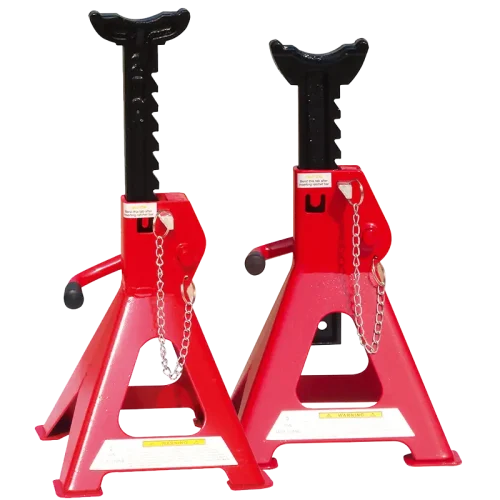
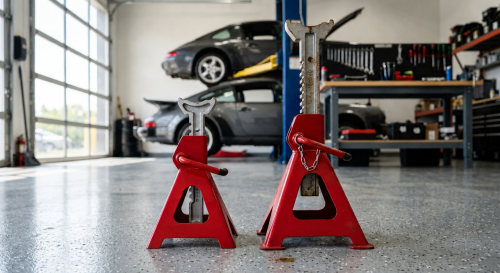
Steel jack stand supporting the front axle of a pickup truck
3-Ton Stands: Where They Actually Belong
A 3-ton jack stand pair is the workhorse for anything under roughly 5,000 lbs curb weight — think Honda Civics, Toyota Camrys, compact SUVs like a RAV4, and most sedans that make up daily traffic in an independent repair shop.
For example, a general repair shop doing brake jobs, oil changes, and suspension work on commuter cars doesn’t need anything heavier. Stocking four to six pairs of 3-ton stands covers 80% of walk-in jobs without wasting floor space on bulkier hardware.
They’re also the better fit for detailing studios and tire shops where turnover speed matters more than raw capacity — lighter stands are faster to position and stack away between vehicles.
6-Ton Stands: Built for the Heavy End of the Shop
Once a shop takes on full-size trucks, cargo vans, or light commercial vehicles, 3-ton stands stop making sense — not because they’ll snap immediately, but because the safety margin shrinks to something no responsible shop should accept.
A Ford F-250, for instance, can weigh over 7,000 lbs before you add a service body or tow package. Front axle weight alone can push past 4,000 lbs on some configurations. That’s exactly the scenario 6-ton stands are engineered for — wider bases, thicker load pins, and taller ratchet ranges to clear larger tires and lifted suspensions.
Fleet maintenance garages and shops handling trucks and commercial vehicles should standardize on 6-ton stands as the baseline, not the exception.
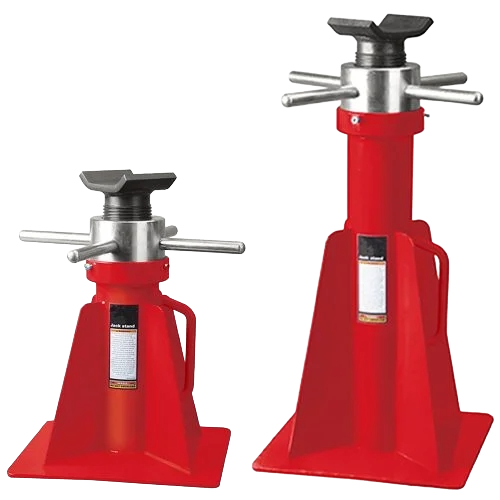
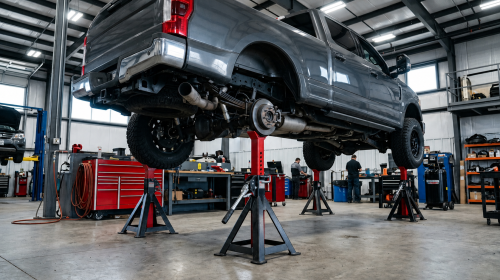
Heavy-duty 6-ton jack stands under a full-size pickup truck
Mixed Fleets Need Mixed Stands — Here’s the Practical Setup
Most multi-bay shops aren’t exclusively servicing sedans or exclusively servicing trucks. A tire center might see a compact car in bay one and a diesel pickup in bay two, same afternoon. Trying to make one capacity class cover both is where corners get cut.
A practical stocking plan for a mixed general-repair shop:
4 pairs of 3-ton stands for daily sedan and light SUV work
2 pairs of 6-ton stands reserved for trucks, vans, and anything over 5,000 lbs
Clear bay labeling so technicians grab the right stand without guessing
For instance, a tire service center running both retail sedan traffic and a fleet contract with a delivery company keeps both classes on hand — and trains staff to check the door-jamb weight sticker before grabbing stands, not after the vehicle is already in the air.
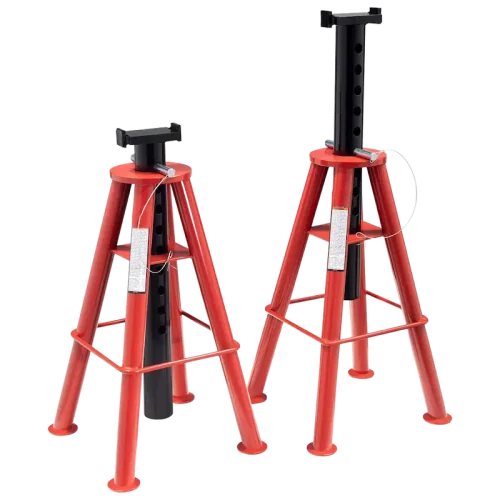
Workshop storage rack with both compact and heavy-duty jack stands
What the Rating Number Actually Means (And Doesn’t)
A ‘3-ton’ stand is rated per stand, not per pair — so two 3-ton stands support 6 tons combined only if load is distributed evenly, which it rarely is on uneven garage floors or during frame work where weight shifts toward one side.
We cover this in more depth in our breakdown of jack stand safety ratings, but the short version: the number on the label is a maximum, tested under ideal lab conditions with even loading. Real workshop conditions — oil on the floor, a technician’s body weight added mid-job, slightly uneven concrete — all eat into that margin.
This is exactly why undersizing is far riskier than oversizing. A 6-ton stand under a compact car costs a little more upfront and takes marginally more storage space. A 3-ton stand under a loaded pickup can fail without warning.
Height Range and Ground Clearance Matter Almost as Much as Capacity
Capacity gets all the attention, but height range quietly determines whether a stand even works for your vehicle mix. Lowered sport compacts might need a stand that sits under 11 inches at minimum extension, while lifted trucks or vans with aftermarket suspension need 18-21 inches of reach.
A shop that buys 6-ton stands assuming ‘bigger covers everything’ can get caught out if the minimum height is too tall to fit under a low-clearance sedan’s pinch weld. Always check the compressed height spec, not just the maximum.
If your shop regularly services a wide range of ride heights — say, both lowered detailing customers and stock trucks — consider stands with a wider adjustment range rather than assuming one capacity class solves both problems.
Technician adjusting jack stand ratchet height mechanism
How Jack Stand Capacity Fits Into Overall Lift Safety
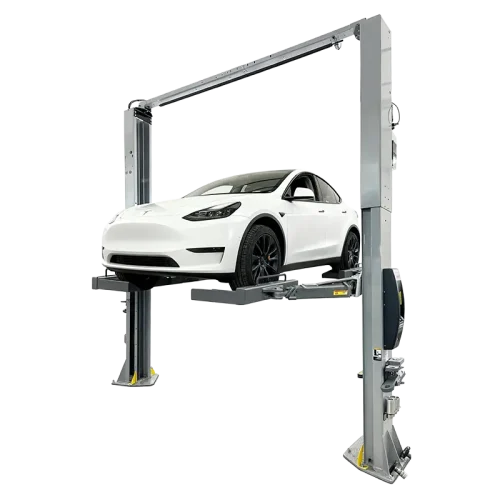
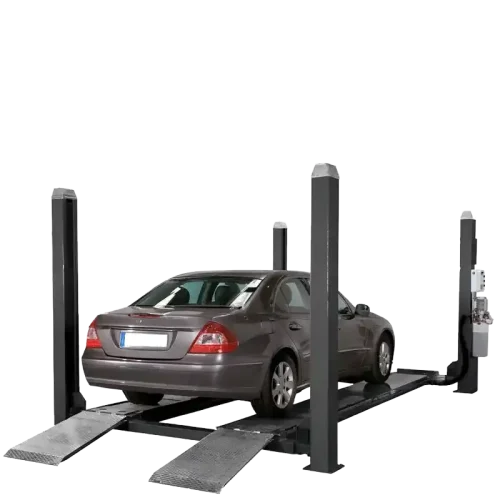
Jack stands are almost always the backup, not the primary support — hydraulic jacks, floor jacks, or a full 2-post or 4-post lift typically raise the vehicle first. But the stand is what actually holds the vehicle while someone’s underneath it, which makes its rating the last line of defense, not a secondary concern.
Shops running a formal lift safety inspection routine should fold jack stand capacity checks into the same schedule — checking for bent pins, cracked welds, and worn ratchet teeth alongside lift maintenance, not as an afterthought.
Quick Decision Guide: Which Capacity to Buy
If you’re still unsure, use this shortcut:
Choose 3-ton stands if your shop mainly services passenger cars, hatchbacks, and light SUVs under 5,000 lbs curb weight.
Choose 6-ton stands if you regularly work on full-size trucks, vans, or any vehicle where front or rear axle weight exceeds 2,500 lbs.
Stock both if your shop sees a mixed fleet — this is the norm for most independent and tire service shops, not the exception.
See the comparison table below for a side-by-side breakdown of specs, pricing, and best-fit use cases.
Yes. We provide OEM and ODM services, including logo printing, custom colors, packaging design, and product specification adjustments. Available options depend on the product type and order quantity.
What is your minimum order quantity (MOQ)?
MOQ requirements vary by product. Most standard products are available in flexible quantities, while customized branding, packaging, or product development may require a minimum order. Contact us with the product model and required quantity for confirmation.
Do you offer samples?
Samples or trial orders are available for most product categories. Sample charges and refund terms depend on the selected product and will be confirmed before ordering.
Which ports do you ship from?
We can arrange shipment from major ports in China, including Shanghai, Ningbo, Shenzhen, and Qingdao. The final port will be selected according to the product location and shipping arrangement.
Which trade terms do you support?
We support EXW, FOB, CIF, and other standard international trade terms. The available option will be confirmed in your quotation based on the order and destination.
Can you supply products beyond your catalog?
Yes. If you cannot find the required automotive tool or workshop equipment in our catalog, send us your specifications, target quantity, and application. Our team can help identify and source a suitable solution.