Spot Weld Dent Pulling vs Paintless Dent Repair: Key Differences
Paintless dent repair and spot weld dent pulling solve different problems. PDR pushes or glue-pulls a dent back into shape while the factory finish stays on the panel; spot weld dent pulling welds a stud, tab or washer onto the panel and pulls the metal with a slide hammer or puller, which burns the coating at every weld and always ends in refinish. Use PDR when the paint is intact, the dent is shallow and there is rear access, and use spot weld pulling when the paint is already broken, the crease is sharp, or the panel is being refinished anyway.
Key takeaways
A welded repair is a refinish job by definition, because every stud weld burns the coating, so PDR only wins while the paint is still intact.
Check paint condition, rear access and steel grade in the first minute; cracked paint or a sharp stretched crease rules PDR out and points straight to a welder plus filler.
Judge a dent puller on minimum weld current, shortest weld time and duty cycle, not on the headline wattage printed on the marketplace listing.
Do not weld steel studs to aluminum: use aluminum stud welding where the OEM procedure allows it, or glue pulling with correct surface prep.
Cost per pull is stud cost plus tip wear, multiplied by pulls per job and jobs per month, and it matters more than purchase price once dent work is weekly.
How Spot Weld Dent Pulling and PDR Actually Move Metal
PDR is a pushing and levering process. A technician works a rod or lever behind the panel, uses the existing structure as a fulcrum, and walks the metal back out. When there is no rear access, the same idea happens from the outside with glue tabs and a mini lifter: the tab grips the paint, the lifter pulls, and the tab comes off with a solvent or release agent. No paint materials get consumed, no bare metal gets exposed, and the factory finish goes back to the customer untouched.
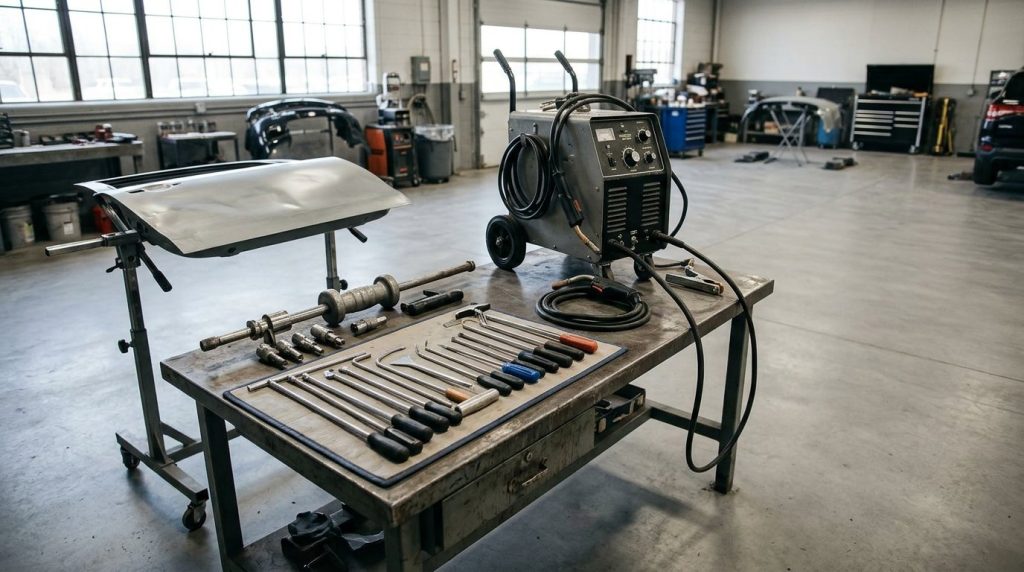
Spot weld dent pulling is a pulling process that starts with a joint. A stud, pull key, washer or rivet is welded to the panel surface, then a slide hammer, squeeze-handle puller or lever bar applies the load. The weld is the load path. That is why the process cannot be paint-free: every weld leaves a bare-metal spot and a small heat mark, and those points have to be ground, treated and refinished.
Neither method adds metal. Both move steel that the impact has already stretched, so a pulled crown still needs tapping and shrinking before filler goes on. Hammer-and-dolly work and heat shrinking sit around both methods rather than replacing them. A shop that owns a welder and nothing else will over-pull dents it should have tapped down in five minutes.
The commercial difference is just as sharp. PDR is priced per dent with almost no material cost and depends heavily on technician skill. Stud welding is a body shop process: it ends in primer, sealer and topcoat, so it carries booth time, paint materials and the painter’s schedule along with it. That framing runs through the rest of this guide. Pick the method from the damage, then pick the machine for the method.
Close-up of a welded stud on a car door panel with a slide hammer attached and a heat mark beside intact paint
The Decision Starts With the Paint, Not the Dent
Paint condition decides whether a paint-free repair is still on the table, so run your eye and your fingernail over the finish before you study the dent.
Run a fingernail or a straight edge across the crease. Cracked, chipped or crazed paint takes PDR off the table, because the customer will see the damage after the dent is gone.
A soft, paint-intact dent with rear access is PDR or glue pulling territory. Welding it converts a same-day paint-free job into a multi-day refinish.
Once the paint is broken, PDR’s whole value proposition disappears. A stud welder plus filler is cheaper for the customer and more predictable for the shop.
A stud welder is not a PDR replacement inside a body shop. It gets a panel close enough to skim, and that is the job it should be judged on.
Stretched metal is the tell for both methods. A dent that oil-cans when you push beside it will not come out cleanly with either, and may need shrinking or replacement.
Capability reality: a shop with no booth and no painter cannot sell a welded repair, and a shop with a booth that turns away paint-broken dents is leaving work on the table.
Paperwork matters. A welded repair is documented as refinish work, while PDR is often billed as a paint-free repair, which affects how insurers and warranty providers treat it.
Here is the same decision in one view:
Criteria
Paintless Dent Repair (PDR)
Spot Weld Dent Pulling
How the metal moves
Pushed from behind or glue-pulled
Stud welded on, then pulled
Factory paint
Stays intact
Burned at every weld
Refinish required
No
Yes, always
Rear access needed
Usually yes
No
Best damage type
Soft dents with intact paint
Sharp creases, cracked paint
Skill dependency
Very high, technician-led
Moderate, process-led
Shop requirement
PDR tech and panel access
Welder, booth, painter
Aluminum panels
Yes, with dedicated rods and glue
No, steel studs are incompatible
Where PDR Stops Working: Access, Steel Grade and Dent Shape
Paintless repair has three hard limits, and the first is access. PDR rods need a clear path behind the panel. Double-skinned panels, bonded panels, inner reinforcements, bracing and window regulators all remove that path, and no amount of skill puts a rod where there is no cavity. When the back is blocked, the choice narrows to glue pulling on the outside or a welded repair.
Steel grade is the second. High-strength and ultra-high-strength steels spring back harder and resist being persuaded, and some OEM repair procedures restrict or prohibit straightening on those grades. Check the OEM position for that specific panel before quoting the job, because a repair that contradicts the manufacturer’s procedure is a liability, not a shortcut.
Aluminum is the third. It can be moved with PDR, but it work-hardens as you go, needs different rods, and cracks if you push too far. Glue pulling on aluminum depends on the correct adhesive and clean surface prep rather than on pulling force, so a tab that pops off is usually a prep problem.
Then there is dent shape. Sharp creases and crowns that have already stretched are the dents PDR technicians decline. Welding makes those dents repairable again, because a stud gives the metal something to pull against and filler finishes what the pull starts. That is the reverse of the usual assumption, which treats welding as the heavy-duty answer to everything.
Glue pulling sits between the two: no heat, no bare metal, no refinish, limited by how well the tab grips the panel rather than by dent depth. Some cases are forced choices rather than preferences. A dent sitting on a hard character line leaves nowhere for a glue tab to seat, and a bonded panel with structural adhesive behind it cannot take welding heat. On those jobs the OEM procedure picks the method for you.
When you cannot pull a dent cleanly, say so at the counter rather than in the bay, and give the reason. Broken paint with a stretched crown means filler and refinish. A crease that has torn the metal, or one that crosses into a structural section, is a panel replacement, and the customer should hear that price as an option before the job starts rather than as a surprise halfway through.
Paintless dent repair tools laid out with glue pull tabs, dent rods and a mini lifter beside a steel panel
When a Stud Welder Should Never Touch the Panel
Resistance stud welding is a heat process, and heat is the part of the spec sheet that product pages leave out. Every weld creates a small heat-affected zone around the nugget. On thin mild steel that zone is manageable and the repair is routine. On heat-sensitive grades it is not automatically acceptable.
What is a disadvantage of spot welding?
The damage is often on the side you cannot see. The weld burns through paint, e-coat, galvanized zinc and seam sealer at the front, and the backside anti-corrosion protection takes the heat at the same moment. You can repaint the front. Restoring the coating inside a closed panel section is much harder, and the unprotected backside is where corrosion gets its start: the zinc or e-coat that was burned away no longer protects the steel sacrificially, moisture collects in the cavity, and the rust works from the inside out where nobody sees it until it blooms through the paint.
High-strength and ultra-high-strength steel repair guidelines frequently limit or prohibit heat straightening. A stud welder is a heat source and has to be treated as one, which makes the machine’s ability to weld at low current for a very short time a safety feature rather than a convenience.
Do not weld steel studs to aluminum as a like-for-like process. Aluminum needs dedicated aluminum stud welding or glue pulling, and mixing the two is how panels get written off. Keep the electrode and the ground path away from fuel lines, wiring harnesses, control modules and panels backed with structural adhesive. If the panel is being replaced anyway, straightening the dent first is wasted labour plus one more heat cycle on a structural part.
The buyer’s question that follows from all this: what is this machine’s minimum weld current and shortest weld time? The low end of the range protects thin panels. Peak output protects nothing.
Weld Current and Weld Time Beat Wattage on the Spec Sheet
Wattage is input power, not control. A 3000W headline says how much the machine draws from the wall. It says nothing about what the panel sees at the electrode, and it is not a measure of how well the machine handles a thin door skin.
Three numbers decide weld quality: adjustable weld current, adjustable weld time, and how the trigger fires. On an auto-sensing system, the electrode senses contact and fires after a short delay. That delay lets the operator seat the stud squarely and consistently before current flows, which reduces spitting, weak welds and burn-through on thin panels. It is more forgiving than instant manual fire, and on a bay where three people share one gun, forgiving is worth paying for.
The low-end test is simple: can the machine weld a 4mm stud to thin panel steel without blowing a hole? Ask for the minimum setting, never the maximum. Duty cycle and recovery time decide throughput on a busy day, because a machine that needs to rest between pulls quietly caps how many dent jobs a bay can clear. Ground clamp quality and cable condition cause more weak welds than the machine does, so treat them as part of the specification rather than as accessories.
Then run the consumable maths. Cost per pull equals stud or tab cost plus tip wear, multiplied by pulls per job and jobs per month. That number is the running cost, and after a year of weekly dent work it usually matters more than the difference in purchase price.
Here is how the three market forms compare. Confirm every figure with the supplier before ordering, because ranges, packaging and voltage differ by model and market.
Criteria
Kit
Compact station
Full station
Weld current control
Fixed or few steps
Adjustable, stepped
Adjustable, wide range
Weld time control
Preset
Adjustable
Adjustable, auto-sense trigger
Duty cycle
Light, occasional pulls
Moderate
Continuous shop use
Accessory set
Basic studs and slide hammer
Studs, washers, pull keys
Keys, tabs, rivets, stitch tools
Footprint
Suitcase, stores on a shelf
Bench-top unit
Fixed trolley or bench station
Price band
Lowest
Mid
Highest
Best for
Occasional dent work
Recon and small body shops
Daily collision volume
Marketplace listings show why the headline number misleads. A 3000W kit and a 4.5KVA kit both describe input power and mode count, and neither tells you the minimum current or the weld time range. That is the specification you actually need, and a price band is not a specification either.
Comparison of two stud welder control panels showing preset dials versus adjustable weld current and weld time controls
Studs, Pull Keys, Washers and Tabs: Which Accessory Fits Which Dent
A long accessory list is not a usable tool set. What matters is whether each consumable has a job on the dents your shop actually sees.
Studs, commonly 4mm and 6mm: point pulls for tight creases and small dents. The smaller stud suits thin panels, the larger one carries deeper damage.
Pull keys and weld-on tabs: welded in a row along a crease and pulled through with a rod or lever bar, so a wide area moves in one action instead of one stud at a time.
Washers: welded over a shallow broad dent to spread the load and stop a high crown being pulled through the middle of the panel.
Rivets, nails, nuts and bolts: single-sided welding for spots that will not take a stud, and for pulling where access is awkward.
Slide hammer, squeeze-handle puller, lever bar: impact pulls for heavier damage, slow controlled pulls for precision, lever work for panel edges and wide creases. They are not interchangeable.
Shrinking electrode or carbon rod: used after pulling, in short trigger bursts, to shrink stretched metal. It is not a pulling tool.
Stitch welding: intermittent current along a tear, rust repair area or patch panel edge. This is the second job that earns a stud welder its bench space.
Kit reality check: seven modes and a long parts list mean nothing if the tabs are thin or the holders will not take standard consumables. The wsatools equipment catalog is a reasonable place to compare what each body repair line actually ships with. Then settle the question that decides whether the kit keeps working: whether studs, tabs and washers are listed as separate reorderable items, what thread the holders accept, and how fast a replacement bag can be on the bench. A machine whose consumables cannot be reordered on their own is a kit that runs out once and stays out.
Does a Dent Puller Really Work? Workflow, Sequencing and Failure Modes
Workflow is where cheap kits and good machines end up producing the same bad result. The machine supplies current. The operator supplies the sequence.
Assess. Paint condition, steel grade, rear access, dent depth and whether the metal is stretched. Decide between PDR, glue pulling, weld pulling and panel replacement before touching the car.
Prep. Strip to bare metal at every ear location with a dry sander or grinder, remove wax and silicone, and clamp the ground to clean bare steel as close to the work as possible.
Placement. Weld ears along the crease or at the deepest point, not in the middle of a shallow bowl. Clustered studs pull a crown instead of removing one.
Pull sequence. Short controlled pulls from the outer edge of the dent inward, releasing and re-assessing between pulls rather than yanking to full depth.
Finish the metal. Tap the crown down, stretch the panel back to shape, shrink if needed, then twist or cut the studs off, grind flush, treat the bare metal and prime.
What does a bad spot weld look like?
Four failure patterns cover most of it:
Pull-off: the stud pops off leaving clean metal underneath. Dirty surface, poor ground, low current or too short a weld time.
Burn-through: too much current or too long a weld time on thin steel, which turns a dent repair into a patch panel.
Over-pulled high crown: too much pull at a single point with no washer to spread the load, leaving a peak that has to be shrunk.
Spitting and partial fusion: a weld that spits, leaves a small crater, or fuses on one side only. A black burn ring much wider than the stud means the current path was wrong.
When you do reach for the shrinking electrode, the working technique is short bursts rather than long burns: push the tip fully against the raised spot and trigger for about half a second, two or three times, then check the surface before going again. The number of pulls a dent needs is set by dent size and crease depth, not by machine power. More current does not remove more metal, and it will not fix a stud placed in the wrong spot.
Step-by-step illustration of the dent pulling workflow from assessment to stud placement, controlled pull and grinding
Safe Operation and Machine Care in a Working Body Shop
Resistance stud welding on a vehicle panel is welding inside a box full of flammable material. Treat it that way.
Fume and coating burn-off: undercoat, seam sealer and sound deadening on the backside can smoulder. Ventilate the bay and do not weld over heavy underbody coating.
PPE: eye and face protection rated for arc flash, gloves, and hearing protection if a slide hammer is running all day.
Fire watch: welding near interior trim, carpet, wiring or fuel lines needs a spotter, an extinguisher within reach, and a check of the area after the last weld.
Ground path: clamp on clean bare metal close to the work. A long return path through painted steel is both a resistance problem and a fire risk.
Cables: check for cracked insulation and a loose torch connection. An inconsistent weld is usually the first symptom of a failing cable, not a failing machine.
Tips and electrodes: dress or replace worn tips on a schedule, because a mushroomed tip concentrates current and burns through thin panels.
Consumables: store studs dry and oil-free. Contaminated consumables weld badly, and the operator usually blames the machine.
Daily check before the first pull: trigger response, ground clamp condition, cable, tip.
None of this is exotic. It is the discipline a shop already applies to a MIG set, applied to a tool that people treat as a hand tool because it is small and light.
Matching the Method and the Machine to Your Shop
The method decision is quick once you look at paint and steel. The machine decision comes down to shop type and volume.
PDR-only shop: rods, glue tabs and lift access, with no welder on the bench at all.
Collision shop: a stud welder as standard, plus a glue pull kit and either a PDR technician or an outsourced PDR partner for the paint-intact work that arrives anyway.
Used-car recon and detailing shops: glue pulling covers most of the volume, with a compact welder for the dents glue cannot take.
Fleet, motorcycle and small general repair shops: the kit end of the market, chosen on low-end current control and consumable availability rather than peak wattage. If the bay is shared with other work, a compact workshop layout guide is a better starting point than a spec sheet.
Panel mix decides the spec: how much aluminum and high-strength steel rolls through the door tells you whether fine low-current control is worth paying for.
Dent volume decides the form factor: occasional work suits a compact kit, while daily volume with several operators justifies a fixed station with dedicated pull keys and a lever bar.
Before ordering from any supplier, confirm minimum and maximum weld current, the weld time range, the stud sizes the holders accept, consumable thread and reorder availability, duty cycle, spare tips and holders, and the voltage and plug type for your market. If you are fitting out a bay at the same time, the complete auto repair shop equipment list and the guide to budgeting an equipment rollout keep the dent station in proportion to the rest of the spend.
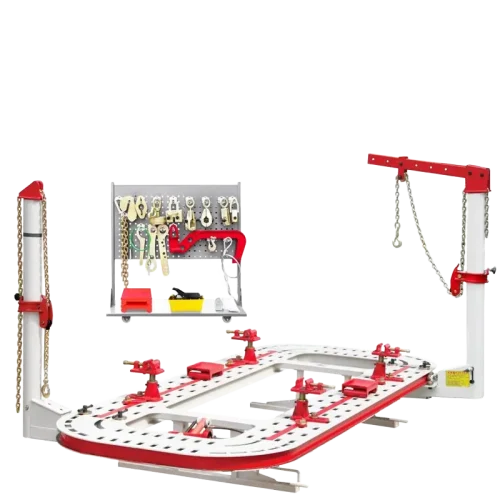
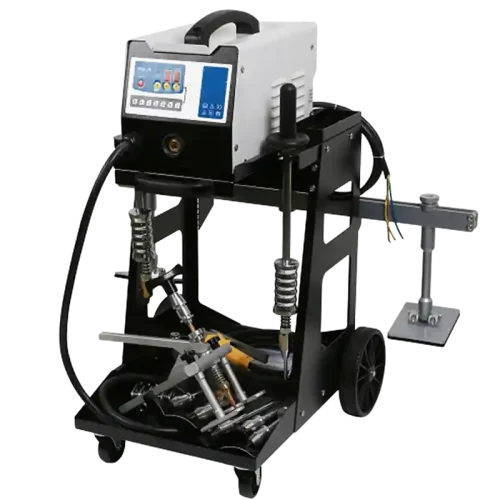
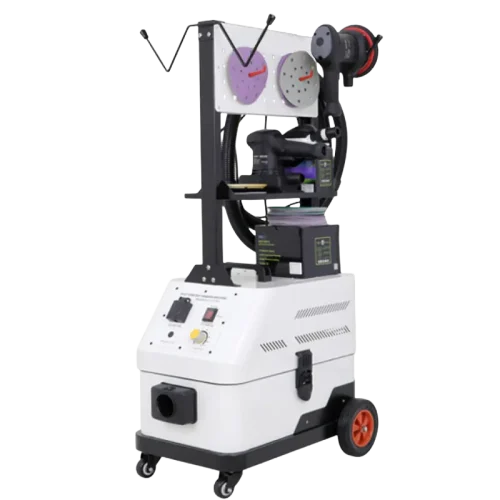
wsatools supplies spot welding dent pullers within its auto body equipment line, alongside auto body frame machines and automotive dry sanding machines, and supports distributors with OEM and ODM branding, packaging and product portfolios tailored to the buyer’s market. Winsen states it chooses trusted factories and runs strict quality checks before shipping, and samples can be requested for most categories with charges refundable once the bulk order reaches the agreed quantity.
Frequently asked questions
How much does spot weld dent pulling cost?
Cost per dent is driven by three things: the number of pulls the crease needs, the studs and tips consumed, and the refinish hours the repair adds. A welded repair always carries booth time, paint materials and painter labour, which is why it is quoted against a panel repair rather than a paint-free dent fix. Ask suppliers for consumable prices per stud and per tip, not just the machine price.
Can you use a stud welder on aluminum panels?
Not with steel studs. Welding steel to aluminum creates a brittle joint, damages the panel and puts heat into an alloy that behaves very differently from steel. Aluminum dent work uses dedicated aluminum stud welding systems where the OEM procedure permits it, or glue pulling with the correct adhesive and surface prep. Check the OEM repair procedure for that panel first.
Do you have to repaint after spot weld dent pulling?
Yes. Every weld burns through the paint, e-coat or galvanized layer and leaves bare metal, so the panel needs primer, sealer and topcoat, and often a blend into adjacent panels for a colour match. That refinish requirement is the main reason a paint-intact dent belongs with PDR or glue pulling instead of a welder.
Is glue pulling better than spot weld dent pulling?
Better only where the paint is intact. Glue pulling needs no heat, leaves no bare metal and consumes no paint, so it is faster and cheaper on soft dents with good tab grip. It fails on sharp creases, broken paint and cold or poorly prepped surfaces. Many shops run both and choose by paint condition rather than by preference.
What size stud should I use for a dent?
Start with 4mm studs on thin panel steel and small, tight dents, and move to 6mm for deeper damage that needs more pull force. Space studs along the crease instead of clustering them in one spot, and switch to washers or pull keys when you need to move a wide area rather than a single point.
Yes. We provide OEM and ODM services, including logo printing, custom colors, packaging design, and product specification adjustments. Available options depend on the product type and order quantity.
What is your minimum order quantity (MOQ)?
MOQ requirements vary by product. Most standard products are available in flexible quantities, while customized branding, packaging, or product development may require a minimum order. Contact us with the product model and required quantity for confirmation.
Do you offer samples?
Samples or trial orders are available for most product categories. Sample charges and refund terms depend on the selected product and will be confirmed before ordering.
Which ports do you ship from?
We can arrange shipment from major ports in China, including Shanghai, Ningbo, Shenzhen, and Qingdao. The final port will be selected according to the product location and shipping arrangement.
Which trade terms do you support?
We support EXW, FOB, CIF, and other standard international trade terms. The available option will be confirmed in your quotation based on the order and destination.
Can you supply products beyond your catalog?
Yes. If you cannot find the required automotive tool or workshop equipment in our catalog, send us your specifications, target quantity, and application. Our team can help identify and source a suitable solution.