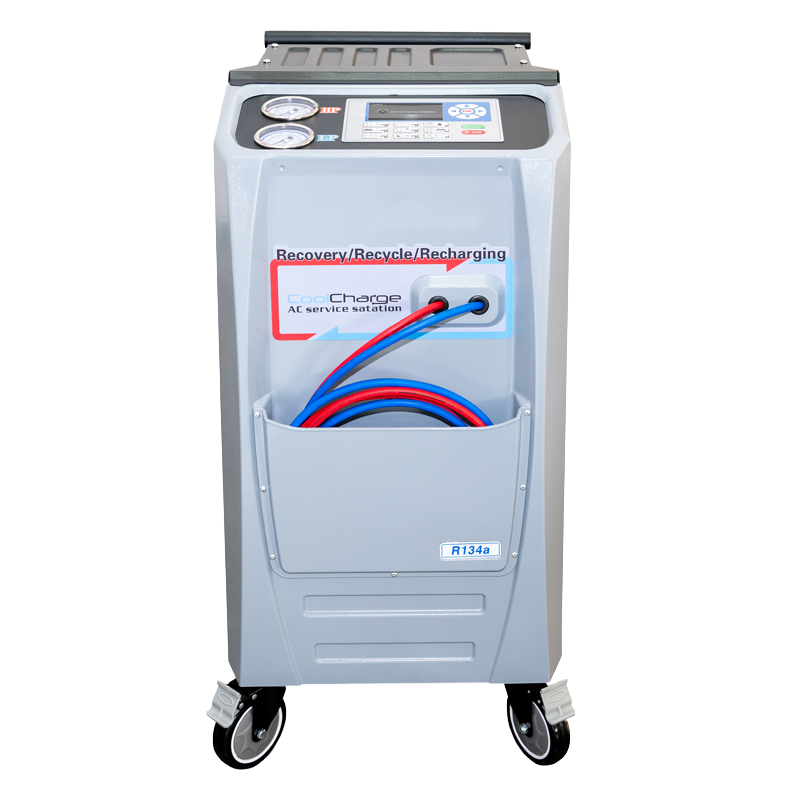
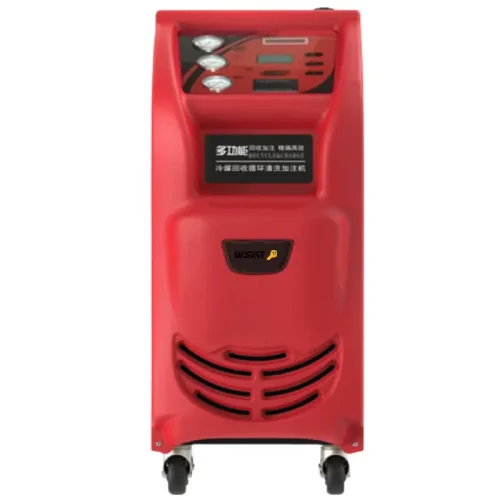
New shop-grade A/C recovery, recycle and recharge (RRR) machines sell for roughly $3,850 to $12,900 at street price in the US market, and list prices on top-end dual-gas units reach about $18,000. Portable recovery-only units sit far below that, at around $1,500. The spread comes from refrigerant support, automation and a few add-on features, and the sticker price is only part of what a shop actually pays.
Automotive AC Machine Price: Typical Ranges by Machine Type
Machine type
What it covers
Indicative street price
Portable recovery-only unit
Recovers refrigerant only; no recycling, vacuum or recharge
About $1,500
R134a automatic RRR station
Recover, recycle and recharge for R134a; some models hybrid-compatible
About $3,850–$5,800
R1234yf RRR station
Single-refrigerant R1234yf, with or without an identifier
About $5,000–$8,300
Dual-refrigerant station
R134a and R1234yf in one machine; top models need no tank swap
About $6,500–$11,300
Heavy-duty and connected units
Large-tank, heavy-duty and WiFi/connected models
About $8,300–$12,900
These are indicative market ranges from US retailer and marketplace listings. They are third-party prices, not Winsen prices: Winsen quotes per order.
List price is a weak benchmark. Several listings pair a “was” or “regular” price with a street price $3,000 or more lower, so only the street price tells you what you would pay.
Marketplace prices can look low until delivery is added. One hybrid-ready R134a unit listed at $3,950 carried $499 delivery, which brings it close to the retailer prices for comparable machines.
The bands also overlap. A well-specified R134a machine can cost more than an entry dual-refrigerant unit, so compare by refrigerant coverage and automation rather than by price band alone.
What Drives Car AC Machine Cost
A handful of features account for most of the spread between machine types.
Refrigerant type: R134a, R1234yf or dual
This is the biggest single step. An R134a-only machine cannot service vehicles that use R1234yf, and the reverse is also true. A machine that handles both without tank swaps costs the most. Your local vehicle mix decides which refrigerants you need, so check what actually rolls into your bays before comparing prices.
Automatic vs semi-automatic operation
Fully automatic units run the recovery, evacuation and charge sequence with minimal operator input. They cost more than semi-automatic stations where the technician steps through each stage. For a high-volume shop, the labour time saved is the argument for paying more.
Refrigerant identifier and purity checking
Some models add an on-board identifier that tests refrigerant quality before it enters the machine. Within one model family, the identifier version typically costs about $500 more than the base unit. Shops that service vehicles of uncertain history get the most from it, because contaminated refrigerant can damage the machine.
Hybrid and EV compatibility
Hybrid and EV compressors typically use electrically insulating oil, so the machine must avoid cross-contamination between oil types. That is why hybrid-ready units cost more than basic R134a stations. Shops adding hybrid or EV work should confirm how a machine handles compressor oil before comparing prices.
Brand, tank capacity, connectivity and support
Established brands price in reputation, parts availability and service networks. Larger tanks, a built-in printer and connected or WiFi models add to the price. Local parts and service support is worth more than a lower sticker price when a machine goes down in a busy week.
Costs Beyond the Sticker Price
The listing price is only the first line of the budget.
Delivery and handling. Heavy upright machines ship as freight, which can add several hundred dollars, and cross-border orders add freight, duties and unloading.
Refrigerant and recovery tanks. A DOT-rated recovery tank costs around $500, and the refrigerant itself is a separate purchase.
Filter driers. These are replaced on the machine’s service schedule.
Vacuum pump oil. It needs regular changes to keep evacuation performance up.
Hoses, seals and scale parts. Charging accuracy depends on the scale and hoses staying in good condition, so keep a small budget for replacements.
Technician certification. In the US, technicians handling vehicle A/C refrigerant need EPA Section 609 certification. Check the rules in your own market.
Calibration and service. The scale and charging accuracy need periodic checks. Ask any supplier what the service interval is and where parts come from.
Add these to the machine price before you work out payback.
New vs Used AC Machine Cost
A used machine is cheaper on the day you buy it, but you inherit unknowns.
Calibration is unverified. Without service records you can’t be sure the scale and charging accuracy are within tolerance.
Wear. Seals, hoses, the vacuum pump and the compressor may be near the end of their life.
Refrigerant support. A used R134a-only unit saves money now but locks you out of R1234yf vehicles, which are an increasing share of the cars shops see.
No documentation. Manuals, parts diagrams and support are often missing.
Used prices vary too widely to benchmark reliably, so treat any used quote as a negotiation against new-unit prices for the same refrigerant coverage.
Buying locally gets you a demonstration, quick parts and face-to-face service, usually at a premium. Distributors, installers and multi-site buyers more often source direct by quote. For either route, request a like-for-like quote listing your refrigerant types and weekly A/C volume so the specifications can be compared properly.
Does an AC Machine Pay for Itself?
Use this formula with your own figures:
Payback (weeks) = total installed cost ÷ (A/C jobs per week × margin per job)
Total installed cost means the machine plus delivery, tank, first consumables and training. Margin per job is what you keep after refrigerant and consumables, not the invoice total.
Illustrative example, not market data: a shop that currently sends out 6 A/C jobs per week and would keep $90 margin on each, with an all-in cost of $7,000, has weekly margin of $540. That gives a payback of about 13 weeks. If your shop only does 1–2 A/C jobs a week, the same machine takes much longer to pay off.
The best candidate is a shop that sends A/C work out today. Those shops lose both the margin and the repeat customer. A shop already servicing A/C with an old machine should compare the cost of the upgrade against lost jobs, for example cars it cannot service because of refrigerant support.
How Much Should Your Shop Budget?
General repair shop: plan for a machine that covers both R134a and R1234yf, so you aren’t turning away newer vehicles. That puts you in the dual-refrigerant price band.
Fleet or hybrid/EV-focused workshop: prioritise hybrid-compatible handling and refrigerant identification, and budget for a model that includes them.
Mobile or low-volume service: a lower-cost single-refrigerant unit or a portable recovery unit can make sense, provided the vehicles you service match its refrigerant.
Winsen supplies distributors, installers and workshop projects with A/C recovery and charging equipment, from semi-automatic and automatic R134a stations to R1234yf-capable models and machines for buses and construction vehicles, with OEM and private-label options. Prices are quoted per order: request a quote with your required refrigerants and volumes, or download the catalogue for the wider range.
New shop-grade recovery, recycle and recharge machines sell for roughly $3,850 to $12,900 at street price in the US market, with list prices on top-end dual-gas units reaching about $18,000. Portable recovery-only units start lower, at around $1,500. Dual-refrigerant, heavy-duty and connected models sit at the upper end. Delivery, tanks and consumables are extra.
What does a refrigerant recovery machine cost?
A portable recovery-only unit costs around $1,500, while full recovery, recycle and recharge stations start at about $3,850. The gap reflects the extra functions: recycling, vacuum, charging by weight and automation. Check that the machine covers the refrigerants you actually service before comparing prices.
Is an R1234yf machine more expensive than an R134a machine?
Generally yes. R1234yf-only stations sell for roughly $5,000 to $8,300, against about $3,850 to $5,800 for standard R134a stations, and dual-refrigerant machines run about $6,500 to $11,300. Dual-gas units without tank swaps are the most expensive. R134a-only machines cost less but cannot service R1234yf vehicles.
How much does a car AC system cost?
For the vehicle owner, the bill depends on the job: an evacuate-and-recharge is the cheapest A/C service, a compressor replacement costs considerably more, and evaporator work is usually the most expensive because of the labour involved. Premium and some EV models cost more. For a shop, the useful point is that nearly every one of these jobs needs refrigerant recovery and recharge.
How much does it usually cost to replace an AC compressor in a car?
The customer bill covers the compressor, a new drier, labour and a full refrigerant service, so it varies with the vehicle, part prices and local labour rates. Premium vehicles cost more. The refrigerant service is the part your recovery and recharge machine handles in-house instead of sending the work out.
What is the most expensive part of a car AC system?
The compressor is usually the costliest single component, and its price depends heavily on the vehicle. The evaporator can cost the customer as much overall because reaching it means removing the dashboard, so labour dominates. A machine doesn’t change part prices, but it controls how efficiently the refrigerant side of the job gets done.
How much is a used car AC machine?
Used prices vary with age, brand and condition and are too scattered to benchmark reliably. The saving comes with risks: unknown calibration, worn seals and hoses, and possible lack of R1234yf support. Ask for service records and a test run before paying, and price a new unit alongside it.
Is it better to buy an AC machine near me or order direct?
Both routes work. Local equipment dealers sell machines with demonstration and nearby service, usually at a premium. Distributors and installers can also order direct from a supplier by quote. Compare delivery, parts availability and service support for your location, not just the machine price.
What’s the best automotive AC recovery machine?
It depends on the shop. A general repair shop with mixed model years suits an automatic dual-refrigerant unit, which typically starts at about $6,500. A fleet or hybrid-heavy workshop should pick a hybrid-compatible model with an identifier. A low-volume or mobile operator can run a single-refrigerant R134a station or a portable recovery unit. Before choosing, compare recovery-only, recovery-and-recharge and full recycling car AC machines side by side.
Yes. We provide OEM and ODM services, including logo printing, custom colors, packaging design, and product specification adjustments. Available options depend on the product type and order quantity.
What is your minimum order quantity (MOQ)?
MOQ requirements vary by product. Most standard products are available in flexible quantities, while customized branding, packaging, or product development may require a minimum order. Contact us with the product model and required quantity for confirmation.
Do you offer samples?
Samples or trial orders are available for most product categories. Sample charges and refund terms depend on the selected product and will be confirmed before ordering.
Which ports do you ship from?
We can arrange shipment from major ports in China, including Shanghai, Ningbo, Shenzhen, and Qingdao. The final port will be selected according to the product location and shipping arrangement.
Which trade terms do you support?
We support EXW, FOB, CIF, and other standard international trade terms. The available option will be confirmed in your quotation based on the order and destination.
Can you supply products beyond your catalog?
Yes. If you cannot find the required automotive tool or workshop equipment in our catalog, send us your specifications, target quantity, and application. Our team can help identify and source a suitable solution.